Human Biology is Inherently Multimodal — Yet the Way AI Handles Data Isn’t

Human biology is complex. We leverage biomedical data across all scales, modalities, and sources into a foundation model, providing a representation of patient trajectories.

Intaking Data from All Sources

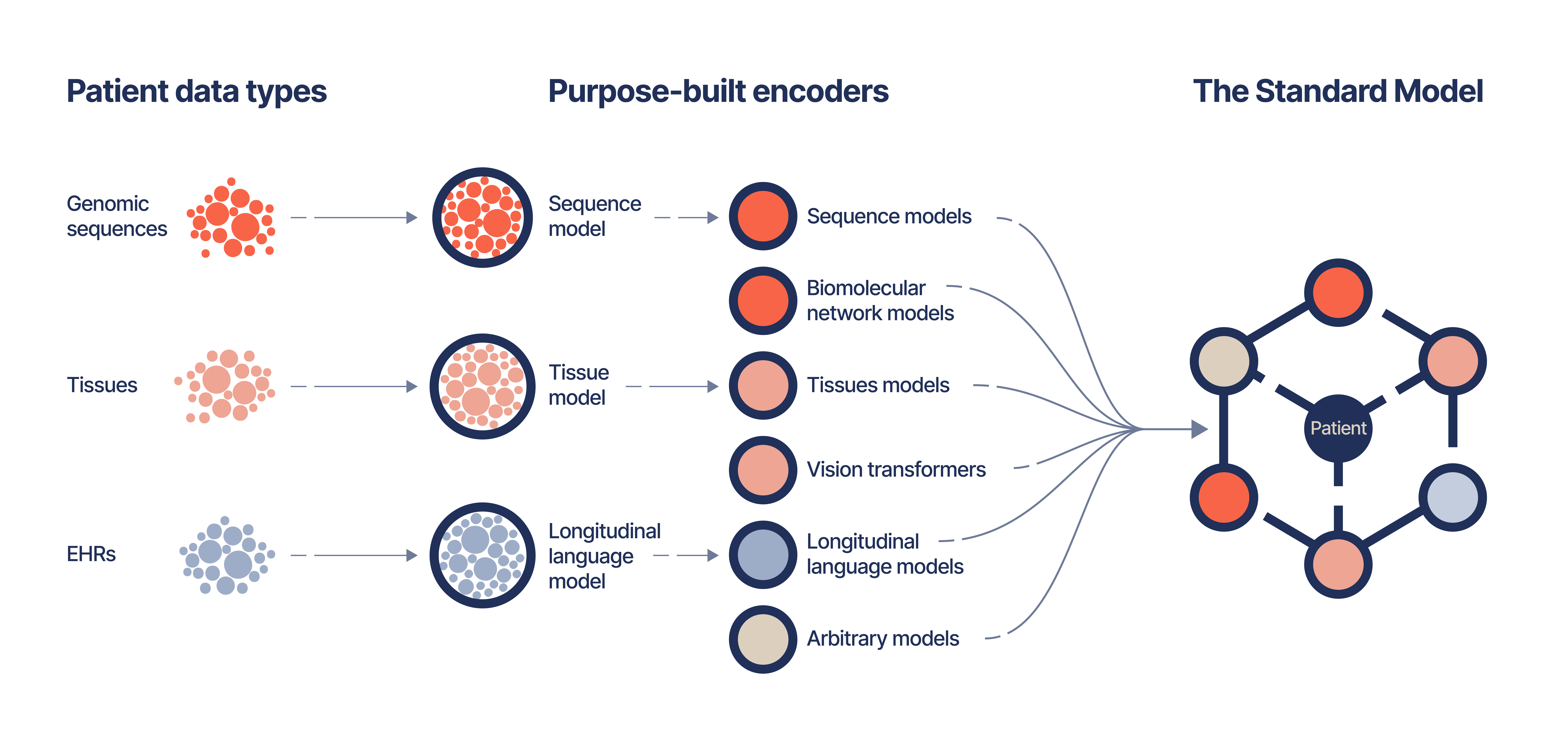
Biology is not limited to linguistic descriptions, and neither are we. Different modalities enter our model through a purpose-built encoder. For example:

  • Genomic sequences → sequence models
  • Proteins → biomolecular network models
  • Radiology images → vision transformers
  • EHR data → longitudinal language models

We incorporate new encoders for new modalities. By preserving the unique structure of each modality, the Standard Model ensures no insight is lost.
Converging to a Shared Patient Space

Patient data are aligned into a mathematically consistent latent space. While this space includes language, it is not solely an LLM; language alone cannot represent the complexity of biology. By representing causal trajectories of disease over time, and incorporating data modalities beyond just language, our model predicts the future state of a patient, not just the next word in a sentence.

Reasoning with Biology

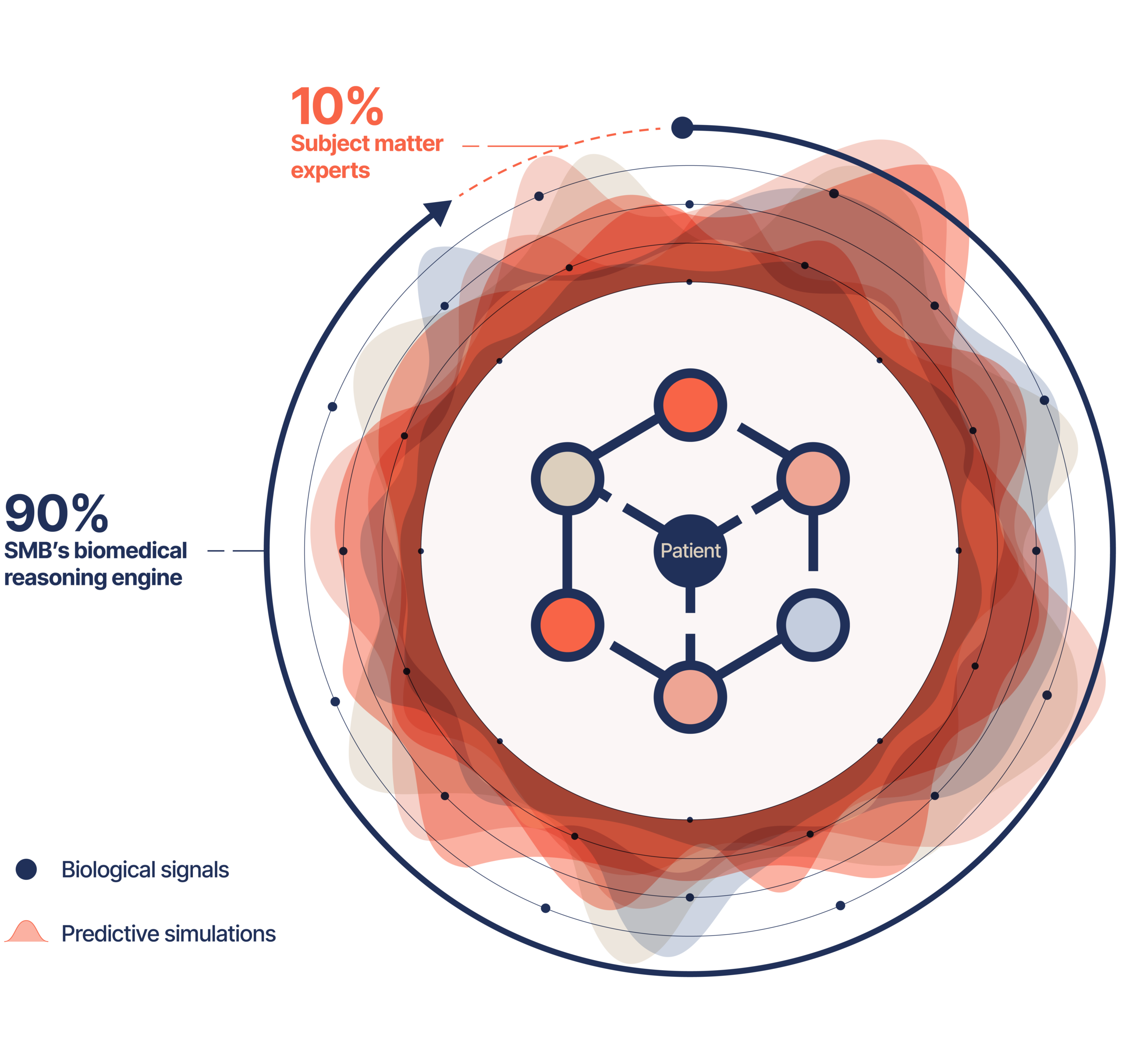
Built for understanding complexity, the Standard Model connects advanced simulations to patient- and population-level insights. We provide task-specific reasoning engines to enhance the capacity of researchers to ask and answer critical questions such as:

For Academic Medical Researchers
  • How will this patient’s disease likely progress under the current standard of care?
  • What early markers signal a future change in disease state or therapeutic response?
  • How might disease progression change if we apply intervention X at timepoint Y?
  • Which patients are likely to benefit most from this therapy, and which are non-responders?
  • What is the counterfactual outcome for this cohort if they receive treatment A instead of treatment B?
  • For clinical trials, how many eligible patients exist in our health system, and what are their characteristics?
For Biopharma Leaders
  • Is this patient in a subgroup that has adverse events when using my novel therapy?
  • Which patients meet our clinical trial inclusion/exclusion criteria?
  • What is the expected event rate for this proposed endpoint in this cohort?
  • What hidden clusters exist in this patient population that aren’t captured in ICD codes?
  • Which features most strongly differentiate mild, moderate, and severe cases?
  • What biomarkers correlate with clinical outcomes?
  • How do genomic variants, imaging findings, and longitudinal EHR trajectories jointly predict outcome X?

Understanding Patients Across Scales

Our model turns signals into insights. With predictive simulations, leaders in academic medicine and biopharma can:

  • Accelerate drug development and trial design
  • Reduce trial failures and optimize patient recruitment
  • Enable personalized care pathways
  • Employ a reusable, scalable AI infrastructure across multiple programs and therapeutic areas
Our Impact

Our Standard Model is the first foundation model built for the multimodal, complex, and interconnected human body — and one designed to collaborate with the entire ecosystem. Partner with us to accelerate research, unlock siloed data, and deliver medicines faster.